
Pine, Ink, and Aftercare
A sensual winter night in a hospital exam room, where consent is negotiated, bodies are reclaimed, and queer caretakers write their own ledger of desire.| Explicit gay erotica, 18+.
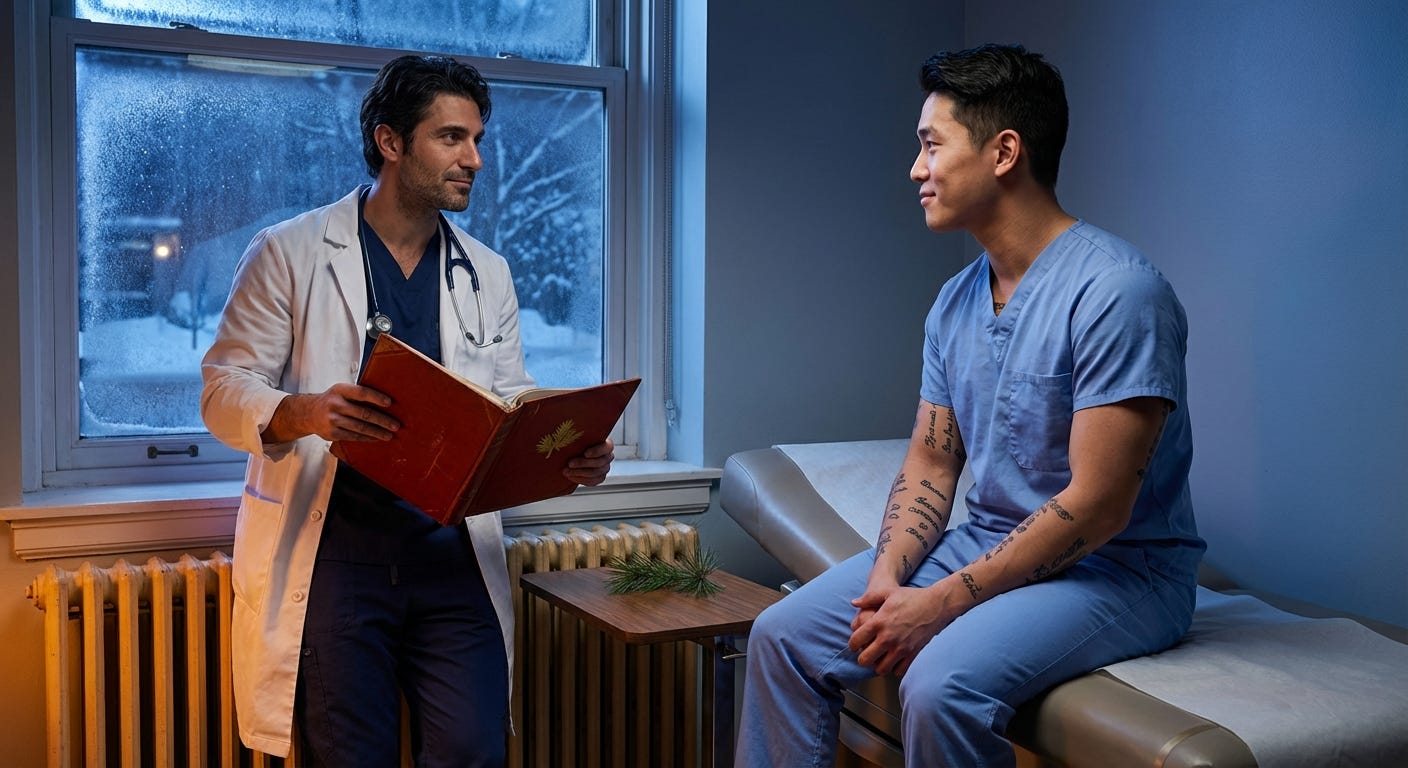
Pulse Under the Snow
The radiator hisses softly, filling the room with a warmth that carries the spirit of December, an evocative blend of antiseptic and pine. I am Dr. Collen, a physician at this hospital, and have long learned to listen for footsteps in such old corridors, ones that pause when you think you can't hear. I recognize the rhythm of Thomas's tread; his presence smolders like the scent of melted snow on heated skin. Our professional relationship has been shaped by shared moments of quiet understanding in the chaos of medical emergencies. Even as I sit with my back against the radiator, that warmth is a reminder of the season and our history. Thomas opens the door, a careful sound that isn't quite a click, more of a hush, as if the room itself concedes to keep his secrets. He stands poised in the doorway, his posture defined by years of careful boundaries and the invisible choreography of immigrant manners. Thomas, a former resident now a trusted colleague, is in dark scrubs, sleeves rolled back to reveal wrists marked by ink: sigils never translated, black against brown skin. His tattoos are deliberate, precise sacraments that contrast his controlled, warm touch. I am reminded of our shared moment one winter evening years ago, when we barely spoke, yet understood each other completely as we waited in silence for a critical word from the surgical team. That night, Thomas's steady presence was the only thing keeping the world in focus, a quiet assurance amidst the chaos.
“Dr Collen,” he says, using the old nickname from his residency. There’s a smile, slanted—like he wants it to be casual, but it lands on me with weight. “You said 5:30.”
Time is ceremonial here in winter, every minute scraped between urgent pages and the hush of snow burying this city’s mistakes.
“I did,” I say, standing to meet him in the blue wash of the radiator’s heat. My bones feel too large for December, but Thomas makes the room feel possible again. “Just needed to finish notes. Glad you came.”
There is a ritual to this, even in the mundane choreography of a holiday health check. Every visit is a checkpoint; the body serves as both ledger and archive. I gesture towards the foldout exam bed, with its freshly rolled white paper—a kind of ceremonial altar. A single sprig of pine, left as a midday prank, still rests beneath the pillow, emblematic of our shared humor. In the unique environment of the hospital, every object carried into the room assumes greater meaning. Thomas, recognizing this, eases off his jacket with deliberate care, acknowledging that the space is imbued with significance. Before settling onto the bed, he meets my gaze, a silent nod to our unspoken understanding. "I'd like to keep this session more focused on mobility and breathing exercises," he says, setting clear boundaries that echo the silent pact we have woven over time. In this ritual, we create a space where queerness can exist securely, honoring the histories and identities of those who have been excluded from traditional narratives, crafting rituals unique to queer healthcare workers who navigate the intricacies of both vulnerability and resilience.
He sits, hands folded, skin shaking off the cold in slow increments. The hospital’s hum fills the silence: overhead chimes, the low croon of distant voices at shift change, the ghost of a caroler in the lobby two floors down. Under that all, the ache builds. Not just between us, but inside me, where memory rubs raw against want. I clear my throat, calibrate to the script even as something disobedient kicks under my ribs. It is here, in the quiet tension, that the nature of our interaction shifts from clinical to intimate, a subtle pivot where duty yields to desire.
“How’s the compression?” I ask, meaning chronic aches, post-surgical tension. But what I want to know is: has December been kind? Have you let anyone touch you, this winter, besides me?
Thomas rolls up his sleeve, exposing the moored muscle of his forearm, the tattoo stark and unblinking against the lamp’s clinical glow. “Pulls more with cold. The old injury acts up. But I’m fine.”
I feel the urge to place my thumbs there—to press into that ink, map every pain and perimeter until the surface gives way to confession. Instead, I keep my touch medical: pulse-check, fingers at wrist, stethoscope diaphragm warmed in my palm. His skin is fire under frost, the smallest tremor of his pulse skipping beneath the surface. I marvel at this, how he allows me close but never fully surrenders. There’s trust here, earned and tested, but its edge is sharp.
“We could try physio again, Thomas,” I offer, voice low. “There are new protocols. And…”
“And?” His eyes find mine, searching.
“And you could write your own parameters this time. Full consent. Every step. You’re not a resident anymore. No one owns your body but you.”
There’s a waver to his breath—short, but not a retreat. Thomas watches me as though weighing the risk of stating aloud what we both feel: wanting to collapse the boundary, wanting something more than the careful choreography of holiday check-ups and coded touches. The city outside is muffled, snow stacking quietly, world closing itself around us. It feels private, even with the knowledge that hospital legends stalk these corridors—old tales of doctors and nurses caught in back rooms during Solstice, the closet where Matron St-James kept a ledger of every forbidden tryst, every bruised knuckle and confession scratched in code. It’s part of the hospital’s real heritage: secrecy as sanctuary, ritual as survival
Consent, Thomas and I have agreed, is not a one-time thing; it’s something you check, again and again. I see him glance at the door, considering which ghosts might be listening: the orderlies, the elves—Janine, the charge nurse, who once winked after a late-night ice run.
“Can we set the rules together?” he asks. It’s a simple question but an enormous thing for him, for both of us. Trauma makes you wary; you learn, sometimes painfully, that bodies aren’t always believed, and care is a currency rationed by those with power. For Thomas, this moment holds the weight of a lifetime policed by societal expectations of race, identity, and national origin—where his queer, immigrant self has navigated a world not always ready to hold him completely. His willingness to claim agency in this room, this winter, feels momentous. It feels like the holiday miracle I want most—the gift not given but chosen. I feel my chest tighten with the weight of his ask and the opportunity it presents. "Yes, together," I respond firmly, meeting his gaze with all the warmth and assurance I can muster, eager to build this foundation with him and let him know he's not alone now.
“Yes,” I say, and the word feels heavier than any snow outside. “We can write every step out. Safety gestures, safe words, built for us. Full circle of aftercare. A ritual, if you want it.”
Thomas softens, just a millimeter. Enough to let color back into the room. “You still keep that ledger, Collen?” he murmurs. “The one from your old attending? The one you swore was only for winter check-ups.”
He doesn’t have to explain what the ledger means. The old red book, cracked leather and gold filigree, sits in my bottom drawer—its pages filled not with names (never that risky), but with coded marks. For every session that meant something, every moment a patient or colleague trusted me, their experiences join the fabric of this ledger. There are symbols for consent, pain, healing, and aftercare—each winter check-up with Thomas marked by a stylized pine, inked green by a secret hand. I recall one entry, a simple circle enclosing a star, that marked the day Thomas finally shared the full story behind an old scar, his trust a heavier weight than any scalpel. Others in the hospital have also contributed, leaving their own secret sigils and stories, adding layers of collective memory. Hospital rumor says it’s a sex ledger, a chronicle of staff hook-ups. That isn’t wrong, just incomplete: it’s a record of mutual bravery, of those moments when queerness and care intermingle, and survival isn’t just statistics but ceremony. The codes we use are as diverse as the people who contribute to them; each marks a testament to the shared community within these walls.
Legend has it that Matron St-James, once the heart and soul of the hospital, began the tradition. She was known for her steadfastness and an uncanny ability to shield her staff and patients from societal prejudices of her time. It's said that during a particularly harsh winter, Matron St-James crafted the ledger not just as a private record, but as a bulwark against the silence imposed by fear. Her markings weaved the language of care into symbols, ensuring that every act of trust and bravery was honored, even if never spoken aloud. The ledger became more than just a book; it was a testament to safe harbors found in halls whispered to hold too many secrets.
“I brought it,” I admit, retrieving the ledger from my bag and laying it between us. The gold emblem catches the radiator’s glow—a pine-needle star, the legacy of a long, secret lineage. “We can update it together, once we’re done.”
A beat passes, the weight of years compressing the silence. Thomas's eyes find the book, move to mine, as if asking: will I still want this when the snow melts? When it's spring again, will we still remember how to claim ritual, how to care for each other in sunlight as well as darkness? The holiday schedule looms heavily over us, a tight weave of obligations pulling us in different directions. The possibility of an imminent transfer hovers, threatening to dismantle the delicate world we've built. Our time here feels measured, the clock ticking faster with each snowfall, pressing the urgency of this December upon us. It makes the moment feel not just intimate, but necessary; a point of continuity in a world of potential upheaval.
He finally nods, firm. “Then let’s do it by the book. Consent, then ritual, then whatever comes next.”
I can’t quite smile, not yet. But there’s a spark under my ribs that wasn’t there before—a rare, precious ache. I see the future in the ledger, in the glow of his tattoos, in the hush of the room, and I wonder what stories we’ll claim for ourselves this winter.
The radiator kicks, the sound like a heartbeat. “Anything else you want to set?”
Thomas’s voice is quiet. “If I flinch, we pause. If it’s too much, you’ll stop.”
“And after?”
He’s slower now, but there’s steel: “You hold me until your shift is over. You write the mark, not me.”
Promise settles between us. There will be a record. There will be aftercare. There will be a tomorrow, even if it’s scribbled in code. Even if the snow never lets up.
A knock raps at the door—Janine’s voice, clipped and familiar: “You two still in there? It’s shift change. Santa’s elves want your consult, Collen.”
Thomas grins at me as he pulls on his jacket, the tattoos hidden but the memory imprinted. “Next time, don’t make her wait.”
I let him go—but not lightly. I hold the ledger against my palm, the pine-needle mark unfinished. The ritual holds. The ache holds. Until next time.
Consent as Ceremony
Snow refreezes the world to glass between check-ups. Our next ritual circles the calendar, and when Thomas returns, he’s carrying the scent of the outside—crisp, metallic cold, half-vanished coffee, city exhaust tangled in the faint shadow of frankincense. The corridor’s gone slim with silence; it’s me, him, the familiar hush of winter-shift ghosts, and the echo of our last negotiation. My hands tremble just faintly around the spine of the ledger as he enters, a small rectangle of cracked red leather that contains more of my longing than my signature.
A nurse in reindeer antlers—Ajay, another of our circle, who knows how to keep secrets—waves Thomas past the duty station with a wink but doesn’t speak. In the architecture of this hospital, quiet is an offer: keep your secrets, as we keep ours.
“Door closed?” I ask too softly.
“Locked it. Janine nodded approval,” Thomas says. There’s pride, maybe, or relief that someone sees us here, still.
I let the ledger lie on the examiner’s side table, open to tonight’s blank leaf. The old code for mutuality, inked in green from the last winter, waits at the margin—a pine sprig half-drawn, an unfinished promise. We balance ourselves between that and new territory.
He shrugs free of his navy coat with none of last session’s hesitation. The room smells different this time: cloth, static, the persistence of holiday tangerine on his wrists from a sunrise snack. He turns one arm over, exposing the script tattoos—black against brown, each character a spell of old survival stories, breakages, firsts, and scars from before our rituals began.
There’s so much we don’t say. We let the calendar’s darkness run on, pushing the ache closer and closer to the surface. I find my stethoscope, spin it between my fingers—something nervous, habitual—and set it down, needing to claim my hands for touch instead of weaponized detachment.
“We can set the boundary lines again, here.” My voice wants to slip clinical, but tonight I hold ceremony in it, not just care.
Thomas looks at me, then at the ledger, the green-inked symbol, the pen. “Read it to me, Collen.”
He means the code—the part I wrote last year, the rules around pain and safety, but he wants to hear it aloud, here, so the witnesses (spectral or of the body) are real.
“Ink means this is voluntary. Pause gesture is two taps. If you want me to stop: three. You pick the point we move from medical to ritual. After—” I pause, because memory and hunger weave together as one, “—you choose how I tend the aftermath.”
His jaw flexes. “Can you add…if I speak in Hindi, and it’s not translation for you, we slow?”
A year ago, he would never have asked. “Done. Hindi is our yellow light.”
He grins, nerves turning honest. “Too much like hospital codes?”
I shake my head. “Codes keep us—me—honest. Safer. More free.”
Our hands meet over the ledger. My palm covers his, thumb mapping the worn valleys of his knuckles, the controlled flex of his wrist. I trace his tattoo—one I know by now: forered shabads, sacred-script, chosen against family exiles, a quiet resistance. There’s history in that ink. My thumb pauses there, asking in touch what I’ve failed to say: how much was taken from you, how much must I return?
He closes his fingers around my thumb.
“I trust you to write the mark, Collen. But only after.”
My nod is half gratitude, half hunger tethered. I feel the weight of the ledger behind us, every page a recalled risk, a winter survived. There’s a reason we keep this ritual in December—the nights longest, the world still dangerous for a queer man of color, even in this city that masquerades at safety.
“I won’t move us forward until you say.”
Thomas’s breathing is slow; glass against the radiator. He glances at the pine needle, the pen, the ritual between us. “Let’s start with an exam. Like always. But after…after you touch, let it be for ritual, not diagnosis.”
For a moment I see us from outside, this choreography a legacy of all those who survived by turning aftercare and risk into encoded ceremony. Janine's late-night wink stuck with me since last session; it was her way of saying: I see you, I remember who came before. I don't forget. Our rituals echo through the night shift, quietly blessed by a community more threaded than obvious. In the maternity ward, I remember hearing Ajay, a nurse known for his deftness with new life and tender secrets, humming an old ballad that comforted more than the newborns. Rumors of Dr. Patel's whispered confessions during breaks, or the haunting melody that sometimes drifts from the understaffed maternity ward, suggest deeper stories, tales of shared understanding and secret alliances. My first illicit touch with a man happened in a call room three doors from here, years ago, when I still believed queer heritage meant secrecy alone, rather than lineage. The walls here have absorbed countless moments, each a testament to the silent strength of those who walked these halls in search of connection.
A sensory echo underscores the stories within these walls: I imagine Thomas's past reverberating through the room, a quick flash to kitchen tiles and shouted names—echoes of a place he once called home. These memories, both fraught and formative, linger beneath his scars, shaping our rituals of care.
Thomas sits, legs flexed, spine against the exam bed, broad hand splayed on his thigh for grounding. I kneel in front of him, not for drama but necessity—leveling power. My fingers bracket his knee through navy scrub pants. I count out breaths. Five. Six. The air between us heats with the radiator, stings noses, dries lips. I feel the hospital’s history pressing behind my ribs: the ledger’s cracked spine, Matron St-James’ rumored closet rituals, old confessions mapped in code. They’re all here with us, ghosts in the linoleum, advocates for our slowness and precision.
His pant leg twitches under my hand; muscle responding before he does. I scan up from there—how the stubble maps the edge of his jaw, how December seemed to etch tiredness under his eyes, how his voice seems both more expansive and more fragile under winter authority and consent.
