Corner Suite Confession
A stranded traveler and a too-kind hotel manager share a room upgrade that turns into a private invitation.
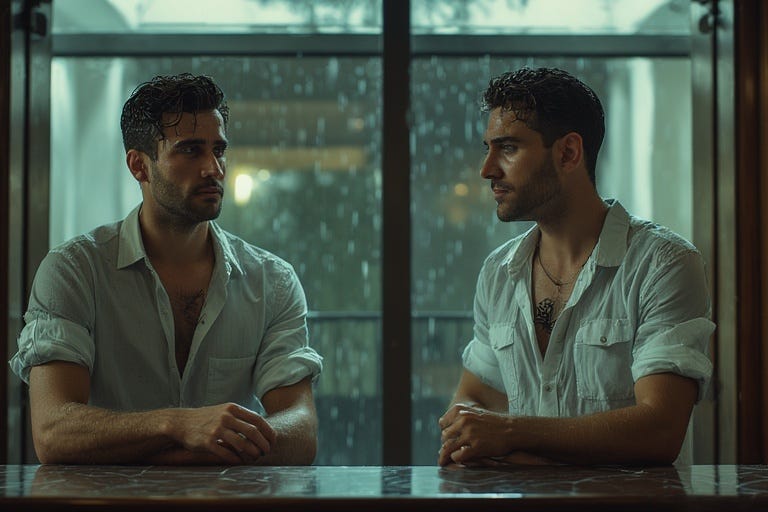
The Room Beyond Reception
People talk about fate like it’s something you notice in the moment—the lightning-strike, the collision, the glimmer of a stranger’s eye across the bustling room. That’s not how it is. Usually, fate is background static, the drip of rain you stopped noticing until it soaks you through. That was tonight at the St. Rose: the gleam of LED slick on linoleum, the low biblical hum of the HVAC, and the hush of suitcase wheels overhead. The world kept running. Only I had jammed to a halt—with a canceled flight, a dead phone, and a reservation lost to the storm. I was supposed to be attending a medical conference, presenting a paper on patient care innovations, yet here I was, stranded. In my ten years as a doctor, I had learned to navigate chaos with composure, but tonight, exhaustion took the lead.
They sent me to the front desk to “work it out.” That’s where he found me. By then, anger and exhaustion had sunk into my joints like old hospital stains. I’d planned to bluff and beg—I always do when I’m cornered, not unlike my first rotation at County Gen, years ago, when terrified men like me trusted a clipboard and a white coat to get them home. But I was the supplicant tonight, leaning awkwardly over mahogany, my backpack slumped, my shoes wet. I practiced the apology in my head—then looked up.
The night manager carried himself differently than hotel staff usually do with late arrivals and late queer bones. There was no forced smile. The gentle question, "Are you all right, sir?", carried less suspicion, conveying more of a ritual comfort. He was young, or at least seemed it: somewhere in his mid-thirties, tall but not in a way that dominated the space. His black curls were just on the edge of messy, and he dressed in dark slacks and a tailored navy shirt rolled up to his elbows, exposing forearms marked with faint, elaborate ink. Around his neck hung a silver tag, the hotel logo engraved, but it was the icon I recognized: four hands and a single flame. It was known as the old queer hospitality sigil. Originally traced back to underground safe spaces, it symbolized unity and sanctuary for queer individuals seeking refuge. I wondered if he recognized me too—or at least sensed the kind of muscle memory I carried behind the eyes.
“I’m Ethan,” I said too quickly, voice trying to steady itself. “I had a room, but—”
“I’m Shaan,” he interrupted, voice low and unafraid to be warm. He stepped to my side of the counter, his hand out—not for my ID, but to shake. His palm was hot, grip a little too firm. Something in my chest unspooled. “The storm did a number on us. We’re triaging. Sit, please.” He gestured to a faded loveseat against the wall, between two potted ferns that had seen better seasons.
No part of his posture rushed me. I registered the word—”triaging”—and note the accented cadence, the quiet intimacy of coded care. This man knew. This building had seen men turn up wordless and broken before. Maybe he’d patched people together in the back offices, or listened to too many drifting guests talk about nights with no exit. I sat, clutching my ruined backpack to my knees. A quick glance revealed other guests: an elderly couple bickering in Gujarati; a trio of smooth-haired men in suits, casting glances at one another, laughing too tightly. The staff watched from behind the counter. But Shaan made me feel—briefly—like the only soul here.
He knelt, far too close to proper, and placed both hands flat on the glass coffee table. “Let’s not be strangers. Tell me what you need.”
It was a simple question. But I heard the code. Hospitals breed ritual: you learn to read the way someone passes a pen or a silence, if it’s safe to ask for more. My left knee bounced; I steadied it. “I just want to not sleep at the airport. I’m not picky. Whatever couch—”
A smile flickered at his lips—not patronizing, but the kind harbor nurses used on anxious residents. “We can do better. Even on a night like tonight, we keep an emergency key for someone who… understands the need.”
He didn’t name it, but I saw how his gaze fell, the way he traced the four hands-and-flame emblem at his neck. The symbol had lived in the margins for decades. A silent network—found in hospital supply closets, back gardens, cracked phone booths—marks of kinship for men who loved men, for those who might lose everything if the world guessed too much. This secret network of symbols and gestures is part of a greater legacy, connecting back to the clandestine messages passed during times when public acceptance was far from reality. It is a testament to resilience and solidarity, echoing through history like the signals shared by those who had to hide but never lost their sense of community.
I remember a rumor from a past encounter, whispered about a certain tea house in Vienna where the brotherhood met under the guise of a gentlemen's club. Stories of men leaving tokens, coded messages hidden within borrowed books in the library, and hurried exchanges of secrets in the spark of a lighter outside. These tales were woven into our shared history, meaningful fragments that connected strangers across borders and time, reminding us that our stories are indeed witnessed, cherished, and shared.
I tried to thank him, but my voice snagged on old habits—compartmentalizing, deflecting, deferring. “You don’t have to put yourself out—”
“I want to.” This time he gave no room for negotiation. He rose, offering his hand. “Corner suite, if you trust me. I’ll comp it—manager’s prerogative. Only catch is, you’ll have to share, if you don’t mind a little company.”
My hand tightened around the frayed backpack strap. A test. Or an opening. The edge of something neither illicit nor entirely safe. “You live here?”
His laughter was quiet, almost apologetic. “Third home in five years. It’s… less lonely, sometimes, with a guest who understands the script.”
I studied him: not a predator, not a nervous host. There was nothing in his eyes but careful interest and—yes—some hope, moon-silvered in the weak hotel light. “I abide by the script,” I managed, more vulnerable than intended.
Rain battered the skylight. Guests came and went in flashes, the staff pretending not to watch. Shaan guided me behind the counter—past a locked staff door, around an empty restaurant space, into a narrow elevator meant for stretchers or carts. The silence between us was built out of partnered rituals: footsteps soft, voices lowered, eyes flickering to hall corners for unseen observers. I inhaled the scent of spent coffee, damp wool, the residue of someone else’s expensive cologne. I tried to quell the shame that came with need—the old wound from years of hospital call rooms and back-alley midnight escapes. Shaan seemed to map it, too, offering a kind of protection I’d forgotten existed.
Our corner suite was disappointingly ordinary. Soft beige carpet, a loveseat, a king bed. The light was dim and yellow, accenting the dampness in my shirt, the rumpled edge of Shaan’s sleeve. He tossed his hotel badge onto the side table—deliberate, a signal. “You can shower, if you want. I’ll grab extra towels. Take your time. We’re not expected.”
There was kindness in the way he retreated, shutting the bathroom door behind me. I stood under the spray, letting the hard water beat against skin that still bore the phantom touch of latex gloves, scrubbed in too many times to remember. My body was a map of jobs, not lovers. A rib scar from a residency accident, a faded tattoo on my hip I’d gotten to spite someone I no longer missed. I wondered—stupidly—what Shaan would see, if given the chance. Did he recognize the body language of men who have always lived on the edge of exposure?
I stepped into the steam, dried off with towels that smelled faintly of bleach and lavender, and found Shaan sitting cross-legged on the big hotel bed, his phone dark beside him, no screens, just waiting.
He gestured to the minibar table. “Tea, or something stronger?”
“Tea’s good,” I croaked, still half-drenched inside.
He poured, hands steady. I watched the gold ring on his right index finger catch the lamp light—another secret marker? His left arm rested on his knee, the tattoo an intricate knotwork pattern spiraling toward his wrist: not medical, not religious, something older, or private.
Shaan sipped, breaking the tension. “There’s a legend in this place—maybe just queer staff gossip, but after midnight, every room has its own secret story. The corner suites aren’t just upgrades. They’re for the ones who need the world to shift, just for one night, to remember how to ask for more.”
My breath caught. “Not much of a legend.”
He grinned, shy but genuine. “We have a logbook—never in writing, just stories passed down. Every manager leaves one thing behind. The cup, the lamp, a suit jacket—the next learns its history. Each object’s a promise someone kept. You’re welcome to leave yours, if you want.”
The ritual. The first real offer. My pulse ticked up. His invitation echoed past hurts and hopes—half hospital, half home. I reached for my mug, letting my fingers brush his.
We talked. Quiet, halting, never naming the thing outright: exiles, lost friends, years of holding desire under the skin. I admitted, once—just barely—that I hadn’t let myself sleep next to someone, not really, since residency. Too many hospital nights ended crumpled on benches, bodies draped for healing but never heat.
Shaan nodded, understanding heavy in his face. "People always think hotels are places for secrets. Mostly, they’re where people remember how to say what they want—just for the night. Tomorrow, we go back to our own stories." As he spoke, there was a moment, a flicker of something more in his gaze—a silent promise that perhaps tomorrow didn't have to mean goodbye. It sparked a quiet hope, leaving open the possibility that their stories might intersect again, somewhere beyond the boundaries of that night.
My throat closed around the remains of my tea. I drew a slow breath, feeling the ache of caution—too much, too soon. There was a freedom here, if I could reach it. I was still that boy outside the call room, watching for the signal that meant safe.
He sensed it. Put his mug aside, not crowding, just—”We can redraw boundaries tonight, Ethan. We can make the rules. If you need me on the couch, I’ll go. If you want company, I’m here until morning.” His eyes flicked, promising consent, not pressure. “We don’t have to explain ourselves to anyone.”
The rain battered harder, silvering the window, well beyond midnight. “No pressure,” I whispered, voice raw. “But I don’t want to be alone—not tonight.”
He let relief bleed into his smile. Then he picked up the silver badge from the side table and pressed it into my hand—four hands, one flame, cold against my palm. “You keep this for now. Tomorrow, when you go, you decide if you want to leave it behind. Or leave something else.”
In that moment, the ache spun between us: rain, ritual, the unspoken promise of a night spent learning the rules of comfort, not just hunger. The world shrank to the corner suite—one room set aside for stories, for telling the kind of truth that leaves a mark.
I curled beside him, not touching yet, bone-tired but alive to the possibility: that morning would come, and this—what we offered each other now—might carry forward. Not just lost to the storm, but logged, somewhere, for the next man to find.
Nightwork and Tender Edges
It’s absurd how loud a hotel room can get when two men try not to be the first to break the careful new quiet. Rain hammered the glass, irregular, a reminder of everything unasked. I sat at the edge of the bed as Shaan tucked his legs beneath him, knees up beneath that navy shirt, eyes softer now that the rituals had started—his badge in my hand, my damp clothes folded over a chair. Every nerve prickled. The badge still pressed into my palm—cool, alive, a focus for every half-done thought. It was stupid how meaningful it felt, the weight and the old symbol—queer hands and flame—echoes of nights in hospital call rooms and city motels just like this. I’d grown up hunting for those signs, even when I pretended I wasn’t.
Shaan poured more tea. The mugs clicked, well past midnight. He steepled his fingers, worry lines deepening around his mouth as if he’d worn that caring look since childhood, always left to smooth out grown-ups’ storms. I watched him watching me, and I wanted to close the space, to lean in and press my face to his collarbone and breathe.
“It’s still raining,” he said, voice low so the words didn’t travel. There were other guests on this floor, I guessed. Shadows moved beneath doors, slippery hints of movement and secrets. But for all that, it felt like there was nobody but us, the world trimmed down to the circle of shared secrets and barely-bridged need.
I trailed my thumb down the badge, tracing each of the four hands, recalling Shaan’s careful way with boundaries. “Were you always this… good at making people feel safe? Does your family know?”
He looked down, color cresting his cheekbones. “Not at first. Grew up watching everyone hold their worries too tight. My mum—she calls hospitality a calling, not a job. Taught me the rituals—make tea, listen, prepare a bed before you ask the hard questions. She’s proud. Dad pretends not to see the badge, but he gave me the ring.” He wiggled his right hand, the gold glint catching the bedside light again. The ring’s inscription was worn thin—someone else’s hands, generations past. “There are rules we write for each other, in families. You probably have yours.”
I bit my lip, feeling the ghost of latex on my skin—the hospital years, the weight of a thousand patient confessions. “Everything I know about comfort, I learned by accident—patching people up when I should have been sleeping. Hospitals have their own codes, you know. Places no one speaks outside the walls—the bench behind radiology, the empty office with a painted over star of David. Nurses used to keep secrets for us, if we asked politely. My family pretends I’m still back east. My father thinks I travel for the work.”
Shaan’s gaze sharpened—solidarity, understanding. “It’s easier to care for a stranger sometimes. There’s less cost.”
We let it settle. Shared silence isn’t nothing between men. It’s its own kind of confession. Shaan shifted, and the mattress dipped. The air grew dense, like waiting for a storm front to finally break. I could feel him studying me—not lust, not yet, just cataloguing want and possibility, as if he meant to log everything for the suite’s living ledger.
I blurted, wanting to tether this—“If we do this—if we break the rule and stay here—the next guest, you’d tell them about us?”
He smiled, slow. “Only the safe bits. The next manager deserves the story, not the scandal. Tradition: every night like this, someone leaves a symbol. Tea cup, lamp, badge.”
My shoulders eased. “I never had a ritual like that before. Hospitals—there are ledgers and charts and always another handoff at dawn. Stories get lost.”
“Maybe we keep something for us,” Shaan said. “Tomorrow morning, after the shift change. Or before you leave. Trade tokens. You decide how much is remembered.”
He paused, the words edged with hope and reticence. “You can back out tonight. Tomorrow, you can walk away, leave the badge, or keep it. Only promise is, I’ll shut the door if you need space. Or open it if you need to come back.”
He knew, somehow, that for men like me—like us—security came from the script, not the improvisation. He handed me the delicate cup, his fingers brushing my wrist. The touch was feather-light, but it burnt. I wanted to arch into it, to beg for the pressure to grow. I could see myself making a ritual of his smallest gestures: opening the bedroom door, flicking the badge by the lamp, letting the world in or out, knowing which promises would need mending come daylight.
I thought of old ghosts—Dr. Weisman’s hand on my shoulder after a code at 3am, the bare hallway where I’d watched someone I loved flinch at the wrong word. Lonely bodies on borrowed couches, too scared to reach out and be found. I looked at Shaan—his fairness, the wary way care sharpened his face—and saw what had always drawn me: men who knew how to tend wounds because they carried so many themselves.
I squared my shoulders, heart scudding. “Truth? I haven’t slept in a bed with anyone in—” I broke off, mouth dry.
“Years,” he finished for me. “Me too. Not since my ex. We used to travel, find the safe hotels, search for the mark in the window. Different city every week, but the same ache: wanting to let someone see you at bedtime, but never quite sure if you’ll wake up to goodbye.”
There was quiet understanding in that. He wasn’t rescuing me; he was offering himself up for rescue, too. The lamp hummed and the rain softened. An ambulance siren ghosted through the heavy glass—a memory of old night shifts. My body ached in old, familiar ways: desire wound with fear, shame tangled in the want to be trusted.
Shaan’s hand lingered near my thigh, palm up, revealing the open promise of the night. His touch was close yet not imposing, the heat of his skin sending an unexpected thrill through me. The air between us crackled with potential, each heartbeat an unanswered question. His quiet confidence wrapped around me like a soft blanket, offering not just physical comfort, but the gentle safety of being seen. "Tonight’s for you, Ethan. You can ask for anything, or nothing. Company, sleep, touch—just say what you want." His words hung in the air, dense with unspoken possibilities, my body acutely aware of the choice being placed before me. I could sense the pulse of the burgeoning connection between us, tender yet insistent, begging to be acknowledged.
I took the offer slowly, sliding my fingers into his, the heat of his skin grounding me. He relaxed fractionally, exhaling with relief. Consent made explicit, ritual made visible between our hands. I shifted closer, letting my shoulder brush his, the dry cotton rasp of his sleeve against bare arm.
“Is this okay?”
Shaan nodded, pupils dilated, hope uncertain but alive. “Boundary check: You want to just stay close? No pressure for more.”
I swallowed, giving myself a second to calibrate. Shaan’s nearness registered in sensory fragments—his cologne, something sharp and herbal, a flash of old tea and skin warmth. His leg touched mine, a point of contact almost bigger than the room, heat gathering where our bodies pressed.
I gave a shallow nod, words failing, and leaned my cheek to his shoulder. The steady pound of his pulse beneath the thin cotton mapped itself onto my own scattered heart. He adjusted, resting his cheek atop my head—the perfect, impossibly familiar pressure. I wanted to believe I deserved this—one night when comfort didn’t need rationing.
We stayed there, not rushing the escalation. He traced idle circles along my forearm, fingertips mapping old hospital scars, the texture of baggage both literal and not. “There’s a story in these hands,” he murmured, thumb stroking a faded burn on my wrist. It wasn’t sexual yet—not fully—but it wasn’t platonic either. His touch catalogued me, not as a possession, not as a target, but as someone carrying the evidence of survival. The rain receded, but the ache only grew sharper.
I wanted to catalog him in turn, so I let my hand wander, following the vines of ink trailing up his forearm—reading each line as carefully as I used to read a post-op chart. His skin was warmer near the wrist, goosebumps leaping beneath my palm. He closed his eyes, letting out a slow, deliberate breath. The framework of consent held steady: every movement was a question, every sigh an answer. Boundaries stayed at the forefront, not as walls, but as gates.
“Talk me through what you want,” I managed, mouth cottony with desire. I needed to name the rules—to link back to the old rituals, make sure neither of us walked out tomorrow feeling like a secret.
Shaan slid his palm along mine—fingers tracing knuckle, wrist, then the inside of my elbow, where nerves wake in anticipation. “I want to hold you. No expectations—just let me log the ache with you for a night. Let it be enough.”
The words lodged somewhere beneath my ribs. I nodded. I let him settle us back into the pillows, arranging our bodies not as strangers but as survivors reckoning with the possibility of being tended to, not simply fixed. He pulled a spare duvet up, wrapping us together, our legs tangling beneath hotel sheets. I pulled the badge onto the bed, resting it between us.
We lay there, our arms wound around each other, the intimacy sharpening as our breaths synced and bodies eased. Occasionally, his hand would drift—a palm grazing my lower back, his thumb finding the scar on my side, both of us logging the map of need and vulnerability. I found myself swiping my thumb with purpose across his pulse, narrating my questions in body language—asking again and again, Are you safe? Am I safe?
His answer, every time, was yes, and more. It was a kind of slow-burning intimacy neither of us had risked in years: not sex, not yet, but something deeper. The anticipation of bodies remembered, warmed in each other’s presence, a promise that tomorrow, we could rewrite our ledgers to include the hope of waking close, not alone. Yet, with hope came the undeniable risk—the heart’s tender gamble against isolation. What if this connection, so carefully fostered in the hushed midnight hotel space, dissipated with the dawn? But there was also the thrill of vulnerability, a part of me yearning to share the narratives written on my skin, the whispered confessions of scars.
In Shaan’s quiet strength, I saw reflections of my own need to be known beyond the clinical competence that defined my waking hours. Each breath held then was both a risk and a promise, the quiet heartbeat of a potential future, fragile yet fiercely radiant.
Without telling the old ghosts to leave, we made room for something new—the kind of story worth logging, the ritual of ache, mapped onto memory, joined in the lamplight.